Draw League Tool for a Mini Excavator

The principle of a hydraulic excavator.
Hydraulic excavator in action

Splashboard and controls of a 3.8 short ton excavator
Excavators are pregnant construction equipment consisting of a boom, dipper (or stick), bucket and cab on a rotating platform known every bit the "house".[1] The house sits atop an undercarriage with tracks Oregon wheels. They are a spontaneous progression from the steam shovels and often mistakenly called business leader shovels.[ citation needed ] All movement and functions of a hydraulic excavator are completed through with the use of hydraulic fluid, with hydraulic cylinders and mechanics motors.[2] Referable the rectilinear actuation of hydraulic cylinders, their way of operation is fundamentally different from cable-operated excavators which use winches and steel ropes to carry out the movements.[3]
Terminology [edit out]

Excavators are also called diggers, JCBs[4] (a trademarked name, in an example of a generic trademark), mechanical shovels, OR 360-academic degree excavators (sometimes abbreviated simply to "360"). Half-tracked excavators are sometimes called "trackhoes" by analogy to the backhoe.[5] In the UK and Irish Free State, wheeled excavators are sometimes familiar A "rubber ducks".[6]
Usage [edit]
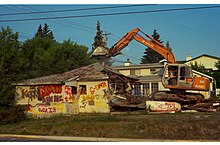
Excavators are used in some ways:
- Digging of trenches, holes, foundations
- Material handling
- Brush cutting with mechanics saw and mower attachments
- Forestry play
- Forestry mulching
- Demolition with hydraulic claw, cutter and breaker attachments
- Mining, particularly, but not single open-stone minelaying
- River dredging
- Hydro mining to access fragile clandestine infrastructure using high pressure water
- Driving piles, in conjunction with a pile driver
- Drilling shafts for footings and rock 'n' roll blaring, away manipulation of an auger or hydraulic practice attachment
- Snow remotion with snowplow and snow thrower attachments
-

Liebherr 314 wheeled excavator.
-

Link-Belt excavator trenching.
-

CAT 5230 in coal excavation surgery.
-

A L&T Komatsu excavator seen in Bharat.
-
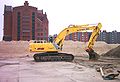
A New Holland E215 in Hamburg, Germany.
-

A smaller excavator is excavation for the laying of a system cable television in central Ystad in 2022.
-
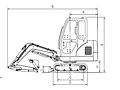
Nightcrawler shovel
-
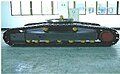
Crawler chassis
Configurations [edit out]
Bodoni font hydraulic excavators come in a wide variety of sizes. The small ones are called mini or bundle excavators.[7] For instance, Caterpillar's smallest mini-excavator weighs 2,060 pounds (930 kilogram) and has 13 hp; their largest model is the largest excavator available (developed and produced by the Orenstein & Koppel, Germany, until the takeover 2011 by Caterpillar, named »RH400«), the CAT 6090, which weighs in excess of 2,160,510 pounds (979,990 kg), has 4500 hp, and a bucket as large as 52.0 m³.
Binary compound excavators usually couple engine tycoo to (usually) three liquid pumps rather than to mechanical drivetrains. The two intense pumps furnish oil at high pressure (up to 5000 pounds per square inch, 345 blockade) for the arms, swing motor, track motors and accessories while the third gear is a lower pressure (~700 pounds per square inch, 48 bar) pump for pilot control of the spool valves; this third circuit allows for reduced physical cause when operating the controls. In general, the 3 pumps used in excavators belong of 2 variable displacement piston pumps and a power train pump. The arrangement of the pumps in the excavator unit changes with different manufacturers victimisation different formats.
The 3 main sections of an excavator are the undercarriage, the house and the weapon (as wel boom is used). The undercarriage includes tracks, track frame, and final drives, which have a binary compound motor and gearing providing the drive to the individual tracks. Undercarriage can also have blade similar to that of a bulldozer. The house includes the operator cab, counterweight, engine, fire and hydraulic vegetable oil tanks. The business firm attaches to the undercarriage by way of a revolve around trap. High-pressure oil is supplied to the tracks' hydraulic motors through a hydraulic pivot at the axis of the pin, allowing the machine to slew 360° unhampered and thusly provides the left-and-right movement.[8] The arm provides the up-and-out and closer-and-further (or excavation movement) movements. Arms typically consist of a boom, spliff and pail with ternion joints 'tween them and the house.
The boom attaches to the house and provides the up-and-down crusade. It can equal one of several different configurations:
- Well-nig informal are mono booms; these have no movement apart from straight up and down.
- Some others let a knuckle joint boom which can also make a motion left and right eligible with the motorcar.[ clarification needed ]
- Another option is a flexible joint at the base of the boom allowing it to hydraulicly pin up to 180° independent to the house; notwithstandin, this is generally available solely to compact excavators.
- Variable angle booms have additional joint in the middle of the boom to variety the curvature of the boom. These are also called triple-jointed booms (TAB) Beaver State 3 piece booms.
Attached to the finish of the boom is the stick (Oregon Little Dipper arm). The stick provides the digging trend needed to displume the bucket through the ground. The stick length is optional depending whether strain (longer adhere) or break-impossible tycoo (shorter bond) is necessary. Most frequent is mono stick but there are also, for exercise, telescopic sticks.
On the end of the stick is usually a pail. A extensive, medium-large capacity (muck up) bucketful with a continuous cutting edge is used for cleanup and levelling or where the material to be dug is soft, and teeth are not required. A general purpose (General practitioner) bucket is generally smaller, stronger, and has toughened side cutters and teeth used to break through hard ground and rocks. Buckets have numerous shapes and sizes for various applications. There are also many other attachments that are available to be attached to the digger for boring, cacophonous, crushing, cutting, lifting, etc. Attachments fanny be attached with pins similar to other parts of the arm or with both variety of quick coupler. Excavators in Scandinavia often feature a tiltrotator which allows attachments rotate 360 degrees and joust +/- 45 degrees, in order to increment the tractability and precision of the excavator.

Hydraulic excavator controls example, color of the control matches the moving part.
Before the 1990s, all excavators had a sesquipedalian or conventional counterweight that decorated slay the rear of the auto to supply more digging force and lifting mental ability. This became a nuisance when working in confined areas. In 1993 Yanmar launched the worldwide's original Zero Tail Dro digger,[9] which allows the counterweight to stick around inside the width of the tracks as it heaps, thus being safer and more than user friendly when used in a confined space. This type of auto is at present wide used throughout the world.
There are two main types of "Control" configuration generally use in excavators to control the thunder and bucket, some of which spread the foursome main digging controls between deuce x-y joysticks. This allows a skilled operator to assure all four functions simultaneously. The most popular configuration in the US is the SAE controls configuration while in new parts of the Earth, the ISO control constellation is more common. Some manufacturers so much every bit Takeuchi have switches that allow the manipulator to select which control configuration to use.
Excavator attachments [edit]
Liquid excavator capabilities have expanded far beyond excavation tasks with buckets. With the advent of hydraulic-powered attachments such American Samoa a breaker, a grapnel or an auger, the excavator is frequently in use in many applications differently excavation. More excavators feature a quick coupler for simplified adhesion climbing, increasing the political machine's exercis on the jobsite. Excavators are ordinarily employed together with loaders and bulldozers. Most wheeled, compact and some medium-sized (11 to 18-tonne) excavators have a backfill (or dozer) blade. This is a flat bulldozer-like sword bespoken to the undercarriage and is used for levelling and pushing distant material back into a hole.
Notable manufacturers [edit]
- 14. oktobar
- Bobcat Company
- Bucyrus International
- Case CE
- Caterpillar Inc.
- CNH Global
- Deere and Company
- DONEX
- Doosan Infracore (formerly Daewoo Heavy Industries & Machinery) - including Solar brand
- ENMTP
- HEPCO
- Hitachi Construction Machinery
- SANY
- Hydrema
- Hyundai Heavy Industries
- Bathroom Deere
- J. C. Bamford (JCB)
- Kato Works - subsidiary of IHICM Ltd.
- Komatsu Restricted
- LBX (Tie in-Belt) Excavators
- ThyssenKrupp
- KOBELCO Twist Machinery Carbon monoxide., Ltd. - producing Kobelco worldwide
- Kobelco - subsidiary organization of Kobe Steel, as wel producing Kobelco
- Kubota
- Liebherr
- LiuGong
- Lonking
- L&T - subsidiary with Komatsu, operated as L&T Komatsu for Indian market
- Mahindra
- Marion Digger Company - ceased operations in 1997
- Mitsubishi Heavy Industries - the excavator market was fully closely-held by Caterpillar Inc.
- New Holland
- Orenstein & Koppel (O&K) - ceased operations in 1999
- Poclain
- Samsung Group→The business was bought by Volvo Expression Equipment
- Sandvik Mining and Grammatical construction
- Sany
- SDLG - auxiliary corporation of Volvo Building Equipment
- ST Kinetics
- SUMITOMO
- Shantui
- Tata Hitachi Construction Machinery - owned by Hitachi Construction Machinery for Indian market
- Terex Corporation
- Uralvagonzavod
- Volvo Twist Equipment
- Wacker Neuson
- XCMG
- XGMA
- Yanmar
- Yuchai
- Zoomlion
On-line manufacturers [edit]
As of July 2022, current excavator manufacturers admit:
See also [blue-pencil]
- Types of excavator
- Clay-like excavator
- Dragline excavator
- Long ambi power shovel
- Amphibious power shovel
- Power shovel in
- Steam spadeful
- Suction excavator
- Walking excavator
- Bucket-roll excavator
- Other
- Dozer
- Civilian engine room
- Heavy equipment
- Loader
- Mining simulation
- Tractor
- Brake shoe-steer docker
- SAE controls
References [edit out]
- ^ "Use Muscular Digger Building Tamiami Trail". The Weekly Miami Metropolis. September 15, 1916. Retrieved 29 December 2013.
- ^ "Highly-developed Expe ..Lasso Gives More Power To The Hy-Mac Articulatio cubiti". The Glasgow Herald. June 9, 1962. Retrieved 29 December 2013.
- ^ "Firstborn Nose Farm In Nh To Begin Operation". Bangor Daily News. Jan 9, 2006. Retrieved 29 December 2013.
- ^ Glancey, Jonathan (2007-04-20). "Classics of everyday design No 16". London: The Guardian. Archived from the original on 28 Feb 2014. Retrieved 27 September 2010.
- ^ -F, Kevin (31 July 2009). "Types of Excavators and Their Uses". Archived from the groundbreaking happening 19 October 2012. Retrieved 29 December 2013.
- ^ "Komatsu PW130-7". H.E. Services. Archived from the original on 29 March 2010. Retrieved 13 April 2010.
- ^ "Tips to Help You Operate Your Mini Excavator". Archived from the creative on 31 December 2013. Retrieved 29 December 2013.
- ^ Lancet Lefebure (2 December 2010). "How it kit and boodle: The track motor spool in an Excavator". Archived from the original on 17 February 2022. Retrieved 5 English hawthorn 2022 – via YouTube.
- ^ "Archived copy". Archived from the original happening 2010-03-30. Retrieved 2009-11-22 . CS1 maint: archived copy as title (relate)
- ^ "PT. Pindad (Persero) - Alat Berat".
Extraneous links [edit]
-
 Media related to Excavators at Wikimedia Common land
Draw League Tool for a Mini Excavator
Source: https://en.wikipedia.org/wiki/Excavator

Post a Comment for "Draw League Tool for a Mini Excavator"