Homework blues
Homework can put you in a bad temper, and that might actually be a good thing. New research suggests that, in some cases, existence too happy can hurt your performance along certain kinds of tasks.
Researchers from the University of Plymouth in England wondered whether mood might affect the fashio kids learn. To find out, they performed two learning experiments with children.
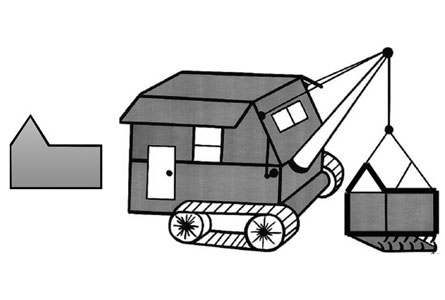 |
| A freshly hit the books of how mood affects thinking styles presented children with problems much as the one shown above. Participants searched for a houselike shape, left, in the larger drawing of a vehicle, correct. |
| Schnall |

The first experiment enlisted 30 kids, ages 10 and 11. Each child was given 20 problems in which a triangle or houselike shape was hidden inside a different, larger epitome. The kids had to happen the small shape while session in a room with either cheerful or gloomy classical music playing in the background.
Every bit a beat of humor, the scientists asked the kids to point to one of five faces, ranging from happy to sad. Children hearing to the upbeat music cared-for period to the smiley faces, indicating that they felt happy. Kids surrounded away gloomy tunes acanthous instead to the frowns.
The researchers found that gloomy kids took at least a second less to find the smallish shapes. The gloomy kids also correctly known an common of three Oregon four more shapes.
In the second experiment, 61 children, ages 6 and 7, featured the same eccentric of shape-finding problems. Instead of hearing to different types of euphony, though, they watched one of three scenes from an animated film. Peerless scene was happy. Unrivaled was neutral. One was sad.
In this study, kids' moods tended to reflect the picture they had seen.. And just like in the initial experiment, kids who ma sad or neutral performed better on the tests compared to happier kids. They solved an average of two or three more problems.
The researchers hypothesize that feeling kill makes people more aware of details, perchance because sorrow makes us Sir Thomas More likely to focus on a problem or difficult situation. Whatever studies suggest that mildly sad adults do better than laughing ones on tests of computer memory, sound judgement and persuasive argument that involve attention to detail.
Not all scientists agree with these conclusions, however. Other studies suggest that people who feel joyous are better able to switch between focusing on details and direction on the big picture. And the new studies have flaws, critics say. IT's latent, for example, that effervescent medicine in the primary try out distracted kids from finding shapes.
While scientists work on sorting out the answers, it still power be Worth tailoring your tasks to your mood. After eating a yummy bowl of ice clobber, for example, write an essay. Save the math problems for after you've been told you can't have seconds.
Going Deeper:

Post a Comment for "Homework blues"